




There are all sorts of good reasons to be happy about living in Colorado: sunny, warm, hardly-humid-at-all days fade into sweater-weather evenings. Of course, there’s the rainfall shortage, low-snowpack contributing to a scary wildfire season. But, hey…rough with the smooth, right? As a fervent gardener, one is used to that scenario. And as the (many) newcomers to this great state are discovering, membership in the Wild Ones local chapters, visits to Denver Botanic Gardens and searching out Plant Select plants when populating your new garden are to be recommended. The same advice, localized, is viable in our sister states of Four Corners (New Mexico, Arizona and Utah) and anywhere west of Fort Worth…as they say, “Fort Worth is where the West begins and the East peters out.”
My garden at the foot of Pikes Peak is where (to my mind) the prairie peters out, so my garden soil is an odd mix of gravel, sand and a touch of fertile soil. It’s the “Steppes” as described in the eponymously named book that outlines the world’s steppe regions, thoroughly describing the plants and ecology of each.
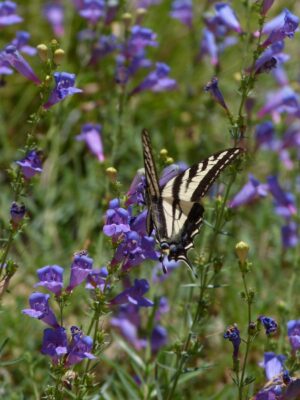
One might be tempted to call the Southwest’s “steppes” the pits, but NO! very wrong indeed. Especially when the huge variety of penstemons that are endemic to this part of the world burst into growth, and flower in a mind-boggling array of color and shape. Penstemon is one of the two largest genera now in the family Plantaginaceae but let us not get into the weeds on that side of the story: there are, in short, a lot of penstemons to choose from.
The prize in my garden goes to P. rostriflous(bridgesii); the flowering stems are easily four feet tall. GASP! Each one covered in tubular orange flowers that go on and on and on. My single plant just appeared one year as a blow in, got its toes into a crack in the patio paving, and just grew and grew. It sets seed late, so I propagate it from root cuttings…root pull ups, really, since the tall stems whip around in the wind and do collapse. So, I just tug a few out, prune them to a sensible lengthy and pot them up in gravelly soil to share with friends.
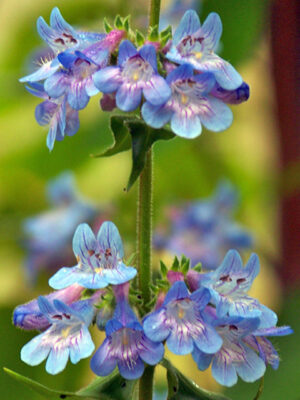
I’ve a number of other penstemons growing here and there around the garden, varying in size, color and habit. A recent prized acquisition was Penstemon procerus, or the Little Flower Beardtongue, the latter being the collective common name of penstemon. Only two feet in height with showy blue/purple blooms, P. procerus is the juicy opposite of tall, lean P. rostriflous. So, I guess the moral of my story is once you find a good thing for the garden, hang onto it; that way happiness is guaranteed.
Oopsie! I didn’t mention, did I, that penstemon flowers of every kind are hummingbird magnets? What else could one possibly want?
©Ethne Clarke 2026
Here follows an assortment of links to an article, a book, nurseries, gardens and organizations to feed into what could easily become a worthwhile horticultural habit:
My review of Denver Botanic Garden’s book Steppes: the plants and ecology of the world’s semi-arid regions: https://hartley-botanic.com/magazine/step-into-steppes-by-ethne-clarke/
Find a local chapter of Wild Ones at https://wildones.org/chapters/
Though long out of print, copies of the Plant Select book remain a good resource: https://www.amazon.com/Durable-Plants-Garden-Plant-Select/dp/1555915906
plus, their website brings it all up to date: https://plantselect.org/new-plants-2026/
Desert Botanical Garden, Phoenix, Arizona is stunning: https://dbg.org
A renowned botanical garden in Utah: https://redhillsdesertgarden.com/
Santa Fe Botanical Garden is a worth a visit: https://visitsfbg.org/
Noted wildflower nursery in Santa Margarita, CA: https://www.laspilitas.com/
A good source of plants for the arid southwest, many introduced by the Plant Select program: https://www.highcountrygardens.com