


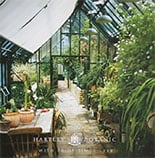

Our local weather forecast is for sunshine, more sunshine, and nothing but sunshine. In fact, we haven’t had a heavy rainstorm since April 23rd. For a gardener, that’s a problem, especially when the local water board has banned outdoor lawn and garden watering because of drought. So what does a gardener do? One answer is mulch – lots of it, spread thickly. And not just any mulch. It’s best to use different mulches for different purposes. So your vegetable beds should be mulched differently than your perennial beds, which is true too for your potted plants and your garden paths.
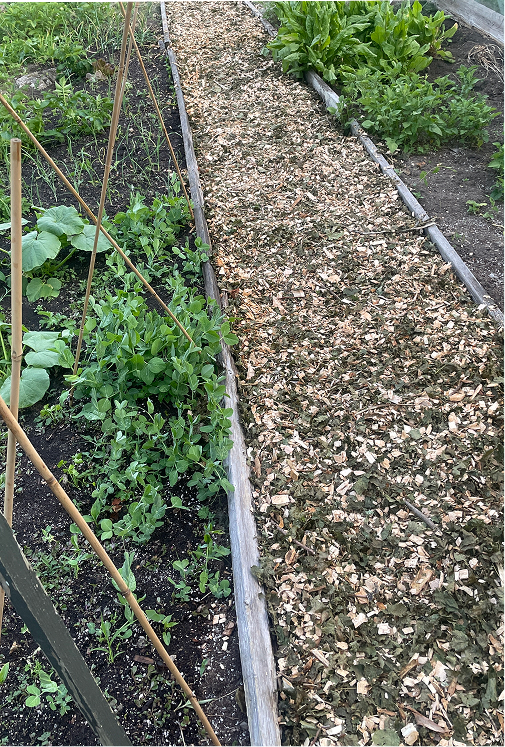
In my vegetable garden, with its large variety of annual plants, I like to use straw or a mixture of leaf and grass clippings. If plenty of leaves are mixed in with untreated grass clippings, the mulch doesn’t compact down too densely, and it slowly decomposes to form compost over the winter. Then, come spring, this compost can be dug in to enrich the soil before new vegetable plants are set out.
On my beds for perennial plants, such as asparagus and rhubarb, I prefer to use shredded straw mixed with well-composted manure. How I grow asparagus is a good example. After harvesting all my asparagus spears over about a six-week period in spring, I allow the ferns to grow to store food for next season. It’s during this early summertime that I fertilize and heavily mulch the bed with the straw and composted-manure mix to keep weeds under control. Using the same mixture of straw and composted manure, I also mulch my rhubarb bed during the hot months of summer.
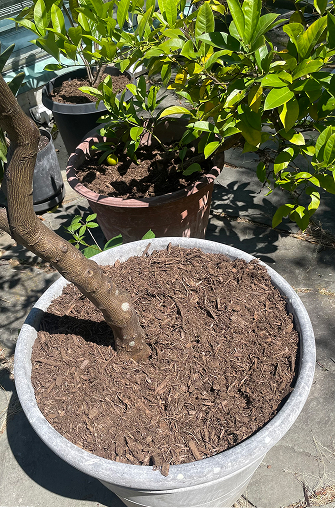
Anyone who grows plants in pots knows they need constant watering, so here too mulch can be used to conserve the water the plants receive. For this purpose, I prefer a commercial shredded bark mulch. But when using this type of mulch around potted plants, you have to be careful that the soil doesn’t get too acidic. Fortunately, soil acidity can be easily tested with litmus paper or with a digital soil pH meter. When mulching potted plants be sure not to put mulch over the graft if yours is a grafted plant. If you cover the graft it is likely that roots will grow from the grafted portion into the doil and you will have a plant that has reverted to its original size.
Another consideration in mulching potted plants is what kind of fertilizer to use. I prefer liquid rather than granules because granules tend to sit on top of the mulch until sufficient water has been added to dissolve them.
As for mulching garden paths, lots of wood chips are my preference. They not only control the weeds. They also don’t decompose very quickly, which is an especially desirable trait for a walkway. Wood chips can usually be obtained from local arborists, who are often only too happy to get rid of a truckload or two. I put six to eight inches of chips on my garden paths after removing the underlying weeds. I’ve been putting wood chips on these paths for so long that the soil under the chips is probably one of the better soils in my garden!