




They say the sixties are now the forties these days, when it comes to age, because many ‘oldies’ are keeping healthy and active for far longer. I count myself as an oldie, very much so, but I hardly ever stop because I have a garden and an allotment to contend with. This year it’s been a lot of watering already, a garden chore that usually falls to the Best Beloved. We, the Royal we that is, only water the containers and greenhouse crops, but it still takes the Rufty-tufty one an age with a hosepipe. I’m expecting a hosepipe ban soon and then it will be cans – and more cans – for both of us. I’ll have to tell myself that all that weight-bearing lifting will be good for my bone density.
So far, we’ve had three heatwaves and they are sorting out the plants that can cope from the ones that shrivel up. I can’t shovel water on them, to use a dodgy metaphor, because it’s such a precious resource. Yes, I know. It rained for most of the winter, or that’s what it felt like at the time, but when your almost 800ft above sea level the water table is non-existent. Some of the border phloxes are in trouble already, especially a white-eyed purple named Phlox paniculata ‘Uspekh’. This Russian-bred phlox, with a name that translates as success in English, is shorter than many but very floriferous. ‘Uspekh’ was raised by P. Gaganov is 1939, but renamed ‘Laura’ by Luc Klinkhamer in the early 1990s. Confusion has remained ever since, not helped by a shorter form dubbed ‘Little Laura’. Whatever the name, it’s looking very limp.

Day lilies, as hemerocallis are commonly called, are amongst the most drought-tolerant plants of all and their linear foliage offers contrast. I like to use them in prominent, but accessible, places. Many are on the corners and that makes it easy to remove the spent flowers every day. I snapped a lovely flower off last week and put it on the garden table minus any water. The flowers stayed pristine for the whole day, due to their waxy texture. And yet, they die so quickly after their day of glory.
Whenever I lift a hemerocallis, I seem to leave a bit behind by accident so it pops up again. That’s probably because they form small sausage-shaped tubers along the roots. This may be the reason why they’re able to survive droughts. They carry their own underground water supply, rather as dahlias do. Daylilies come in a huge range of colours, ranging from cream through to pinks, yellows and reds and their flower shape varies too. The spiders have long petals, but others have taffeta-edged flowers with the same robust quality as an old-fashioned chenille settee. I prefer the more-delicate ones.
The fleshy-leafed sedums, named forms of Hylotelephium, are also survivors and the dark and dusky foliage is untroubled by heat. The domed flowers of the darker forms come in pinks and reds and I use ‘Purple Emperor’ and ‘José Aubergine’. I’ve recently added the purple-pink ‘Thunderhead’ so I’m waiting for their flowers to appear, like tiny stars at dawn. The rest of the herbaceous border is flagging sadly due to heat and lack of water.

The scented pelargoniums tubs, surrounding the south-facing porch, do get watered every day when it’s really hot. However, should we get to go away for a long weekend (an in my dreams thought this one because there’s no chance) they’ll hardly notice due to their South African provenance. Aromatic plants are tough enough to withstand dry weather. When we visited South Africa, they were growing in the Fynbos and they made large mature and rather leggy subshrubs. The Cape climate rarely gets below 10C, or an ambient 50F, so they live for years. South Africa’s climate is the reason why their flora is so diverse. The country didn’t suffer widespread glaciation, a process that wipes out most native flora.
I go for scented pelargoniums with pungent, although the small flowers tend to be insignificant pale-pinks. Favourites, well worth growing and easy to find, are the rose-scented and green-leafed ‘Attar of Roses’, the finely-cut variegated cream and grey-green ‘Grey Lady Plymouth’ and the lemon-scented highly divided green-leafed ‘Radula’. I once gave myself a three-day headache sniffing them whilst writing an article for Gardens Illustrated. Probably best to rub your fingers through the leaves.
We also grow three more-elegant pelargoniums with scented foliage, primarily for their larger showier flowers. The tall and darkly feathered mauve ‘Copthorne’ (1985), the bright-pink ‘Clorinda’ (1907) and the bright-pink and dark-red-feathered ‘Orsett’ are all wonderful. Perhaps the showiest of all, because it’s perpetually in flower, is ‘Pink Capricorn’. Soft pale-green leaves, with a rose-lemon fragrance, frame mid-pink flowers. Three will fill a tub and take you through summer and autumn.
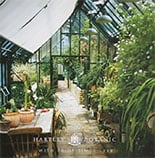
You have to take cuttings of pelargoniums. Left to their own devices, they lose vigour and become leggy and lank and bear very few flowers. And that’s where my Hartley greenhouse comes into its own. Every July I begin to take cuttings. By then this year’s shoots will have developed a rubbery and bendable quality. That indicates that the cutting is semi-ripe, and that makes them perfect.

Scissors at the ready, or take a sharp knife, and then look for new shoots from this year’s growth, about 3 – 4 inches in length or roughly 8 cm. Remove any flower buds and then cut just under the node – the bumpy part where the leaves used to be. Place them in a poly bag to keep them hydrated. They’ll root easily when placed into small seed trays full of coarse horticultural sand. Place them in a poly bag if the weather’s dry. It must be gritty and coarse, not fine. More cuttings are plunged into the damp sand trays up until September. I have some ready-prepared trays sitting waiting.
The mistake people make with cuttings is not placing them deeply enough. Place at least half the cutting in the sand. My cuttings will stay in their sand trays until the second half of winter, because they take up less space. The greenhouse I use has a frost-breaking heater and an electrical propagator. They get potted up into 9cm/ 3 in pots at the end of January and by March they are large enough to place into containers. The containers stay in the greenhouse until late May or early June, before being placed outside. The only cost to me is the electricity needed to heat the greenhouse.
You can raise lots of different plants from cuttings using this sand tray method. They include salvias, lemon verbena (Aloysia citridoria), heliotrope, lavender, phlomis, artemisia, thyme, culinary sage, rosemary, penstemon and dianthus. You can also propagate hydrangeas. If the weather’s dry, water the plant a few hours before you take the cuttings, so that the stems are turgid. This is very important with pinks.
I couldn’t keep these plants from year to year without my beloved Hartley. If I didn’t have one, I would have to buy ready-grown plants and they are expensive and would probably cost £5.00 – £6.00 per plant. The saving appeals to my Yorkshire genes, but the best thing of all is being in the greenhouse in winter sniffing the foliage and dreaming of the summer to come. Butterflies, bees and summer dresses well, what could be better. Some rain thrown in perhaps.