




There are two new greenhouse herbs that are often confused, both relatively unknown a few decades ago now becoming popular. Their confusion is quite understandable as both are from the New World, both in the Apiaceae family, both much used in West Indian, Mexican, Puerto Rican, Costa Rican and South American dishes with almost similar though different flavours.

And to make it even harder both are almost the same word in English with only the exchange of u and i. Culantro and Cilantro, the latter being a form of Coriander grown for the pungently aromatic leaf most often added to salads and on dishes rather than in them as it does not cook well. Culantro on the other hand does so it’s most valued in hot dishes especially soups adding it’s own distinctively stronger coriander like flavour.
First introduced to the UK in 1714 it never became popular in the kitchen until recently. Perhaps because Culantro is Eryngium foetidum, a relation of our native Sea Holly, recognizable when you see the greenish flower-heads but not something you’d think of cooking. (Though see this site March 2023, Sea Holly, for Eringoes, the crystallised roots, which were eaten as an aphrodisiac.)
Culantro is grown from seed, light sandy compost suits best, and germination is surer in a propagator. The plants can be grown on in relatively small pots as they only reach a foot at most, and anyway should be regularly cut back when grown for their foliage. If left to flower they are prettier but no longer of so much culinary value.
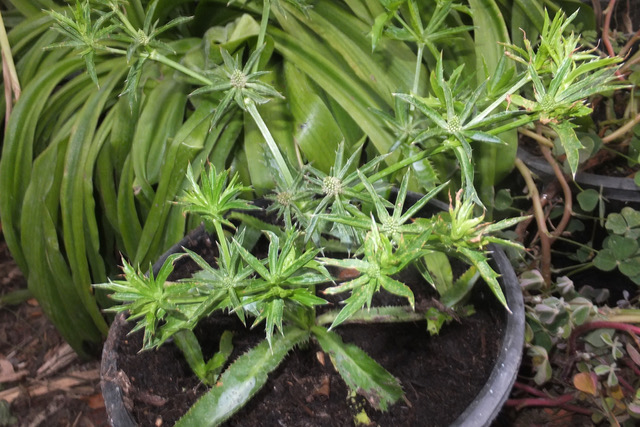
Culantro is perennial though tender so can be grown year round in a warm bright greenhouse, if cold it rapidly succumbs to mould. Otherwise it could not be easier as little seems to bother it save the usual marauding molluscs. Watering needs be regular but light, as does feeding.
The majority of nearly two hundred currently available Eryngium species are grown for their intrinsic beauty. However Eryngium gets it’s ancient Latin name from belch and species such as E. foetidum are thought to aid digestion. Curiously like/dislike for the flavour of Coriander leaf and presumably Culantro is a genetic trait with some folk automatically rejecting whilst others enjoy, most odd.