




Before you put this little book away
Please promise me that will never say:
“You should have seen my garden yesterday.”
It’s been my good fortune to visit a great many gardens in my career as an author of books about garden design, history and, well, gardening in general. In so doing, I have also met the people who made the gardens, designed and cared for them, and more often than not, greeted me with the last line of that little stanza penned by Reginald Arkell, c. 1934. It didn’t matter how gorgeous the garden was looking in the eyes of this beholder, the garden owner could, seemingly, see only the imperfections. Not that I’m not guilty, pointing out a weed, a plant that’s not up to scratch, or one that would look better somewhere else … like the compost heap.
This autumn I’ve had plenty of opportunity to grumble, as there’s not been any rain for what seems like months, but in reality it was only weeks, which was long enough to make perennials go weak at the knees, but perfectly timed with drops in temperature to make the mountains and our Front Range gardens as vibrantly colored as anything the New England landscape could present. Which brings me, at long last, to my point, and a new direction: reduce perennials and Plant. More. Shrubs. especially ones known for good autumn color or bright berries.
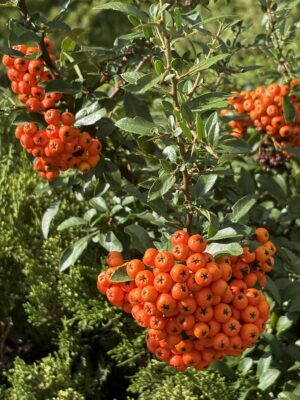
Pyracantha coccinea, commonly called scarlet firethorn, has been a stunner this fall: a dense thorny shrub with small, glossy green leaves, it grows quite tall, and in spring is covered with clusters of bee-friendly white flowers that make the autumn show. It’s well suited to dry, sandy soils
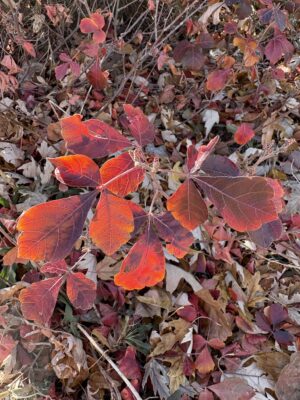
If your focus is to cultivate beauty but limit the number of plants (ahem…perennials) you need to invest in, consider the ground covering shrubs. Rhus aromatica ‘Gro-Low’ is elegant in the way it spreads low growing branches that in autumn are flame red and orange, and in spring racemes of white pearly flowers held above the shiny leathery green foliage.
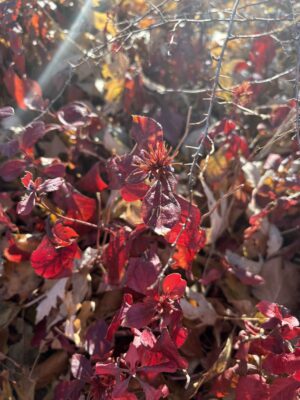
Or check out Ceratostigma plumbaginoides, aka blue-flowered leadwort. It’s more of a carpeting sub-shrub or perennial; in spring the sky-blue flowers dance over the dark green leaves that turn shades of burgundy and dark red before leaf drop and retreating underground to pop up in spring.
So many late season shrubs like this require little attention other than a clip over when the fall show is finished. Add to them some native grasses and the shades of autumn will carry you gently into winter.
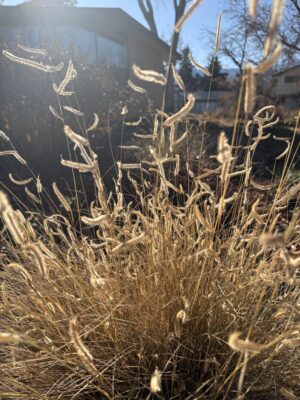
There’s an old gardening adage, that if you want to make the most of your garden, it’s best to keep in mind its limitations. Wise words that have never stopped me; ten years ago, in the mad first flush of making my new garden I planted clumps of prairie bluestem, Andropogon gerardii. It is truly stunning, turning to ribbons of steely blue-grey tinted oyster shell pink in autumn. But it’s a plant of the tall grass prairie ecosystem that grows up to 10ft tall with roots that reach down to China! All I can say is it’s a good thing I love it, because it is here to stay. But as I point out my error to gardening friends, I now add that sometimes it pays to curb your enthusiasm.