




I am spending every moment I possibly can in the garden and every second is precious because the days are getting shorter and shorter. If it’s sunny I have to come in before the sun sinks towards the low horizon and blinds me, so I’m under time pressure when I’m cutting back, tidying and leaf picking. I have a very annoying habit. Truth be told, I have several, but I’m referring to me mislaying my garden hand tools, despite them having bright-red handles.
The Best Beloved has to rescue them for me. He has long enough arms to frisk the green bin, without falling into it and, seeing as you ask, I have accomplished this gymnastic feat all on my ‘ownio’. Trouble was, I couldn’t get out again. Best Beloved to the rescue again – although he did take his time! If my secateurs are not in the green bin, the B.B. has to dismantle the compost heap I’m currently filling. Wherever my prized Felco no 2s are, they are always at the bottom, just like nuts in the muesli packet, they gravitate to the bottom.
The B.B. has suggested a solution. He’s offered to buy me a metal detector as a Christmas present, so I can save him the trouble of rummaging. I wouldn’t put it past him, because he has form. He once gave me a very expensive rain gauge. That’s not the way to a girl’s heart. And that’s all I’m saying. I REALLY need my secateurs at this time of year, along with my Felco pruning saw, because it’s pruning season now that the leaves have dropped. I mention Felco, because their secateurs don’t disintegrate in your hands after a few months, sending springs and nuts into the air, like the cheapies tend to. Felcos last forever. Well, as long as you don’t drop them into the compost heap or the green bin.
The first pruning job is the roses and I have dozens of them at Spring Cottage. When you’re pruning any rose, you start by removing the three Ds, the dying, diseased and the damaged. These are clearly visible at this time of year. Once that’s done you usually create an airy cup-shape from the stronger stems and this is the moment to stand back and look. Weak, spindly stems are best removed. Take your time and never prune anything when you’re on the warpath, or in a hurry. There lies madness, as Shakespeare’s King Lear said.
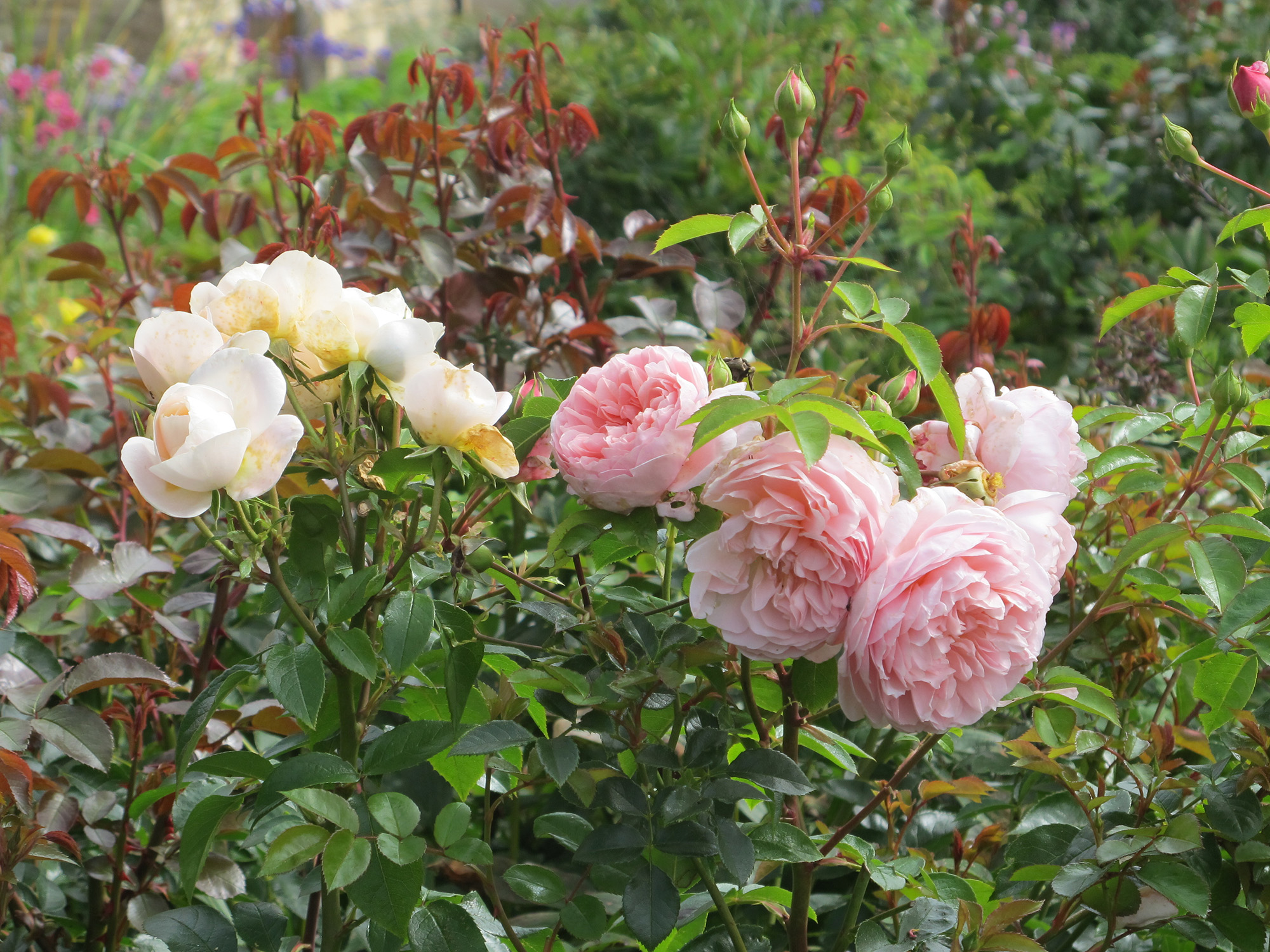
The roses in my rose and peony borders tend to be floribundas or David Austin roses, because these mix with summer herbaceous really well. Floribundas have clusters of at least a dozen flowers on each stem and favourites include the buff-white ‘Champagne Moment’ and strawberry-pink ‘You’re Beautiful’. Their flowers are rarely strongly scented, but they repeat flower abundantly and they both have excellent foliage. Both been awarded Rose of the Year (in 2006 and 2013 respectively) and both have AGMs (the Award of Garden Merit given by the RHS) as well. I can’t recommend these two enough. They have never suffered from disease here and that includes the dreaded fungal disease blackspot.
Floribundas, which are not as hardy as the upright hybrid tea roses, should be cut back to 18 inches in height. Cuts should be made just above an outward-facing bud and you slant the cut downwards from the bud, so that rainwater drains away from the growing tip. If you leave too much stem above the bud you’ll get die-back. You need to select outward-facing buds when you prune, so that the new growth doesn’t grow into the middle of the bush. You should end up with a leafless plant sculpture.
David Austin’s English roses are bred for scent, their graceful habit and old-fashioned flowers. Shape and size vary. I adore the pale-pink ‘Wildeve’, introduced in 2003, because it’s healthy and floriferous. It’s a wide rose, sending straightish stems out at 45 degrees quite often, so I use large semi-circular hoops to protect it from wind damage. David Austin recommends removing a third of his English roses when pruning, but this is reduced by half to restrict its spread.
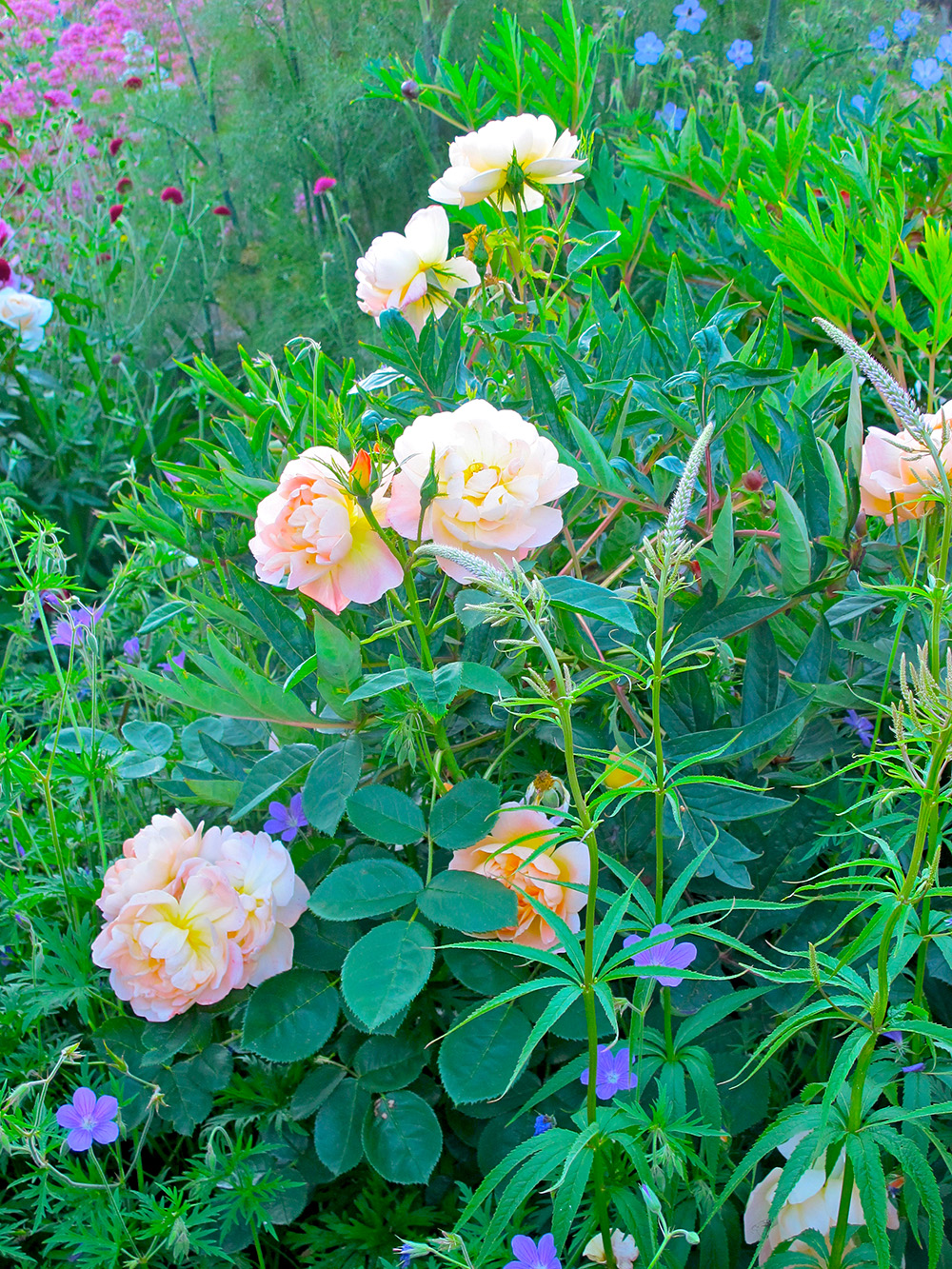
My other favourite Austin rose is ‘The Lark Ascending’ (2012) and this is a tall upright rose for me. The flowers are a sunset-mixture of yellow and pink-orange and it’s hardly ever out of flower, because it puts up new buds when the flower trusses above are still fully out. I cut this down by half as well and I have four in the rose and peony beds, supported by blue flowers. They include Geranium ‘Orion’, Campanula lactiflora ‘Prichard’s Variety’ and Betonica macrantha (previously Stachys macrantha).
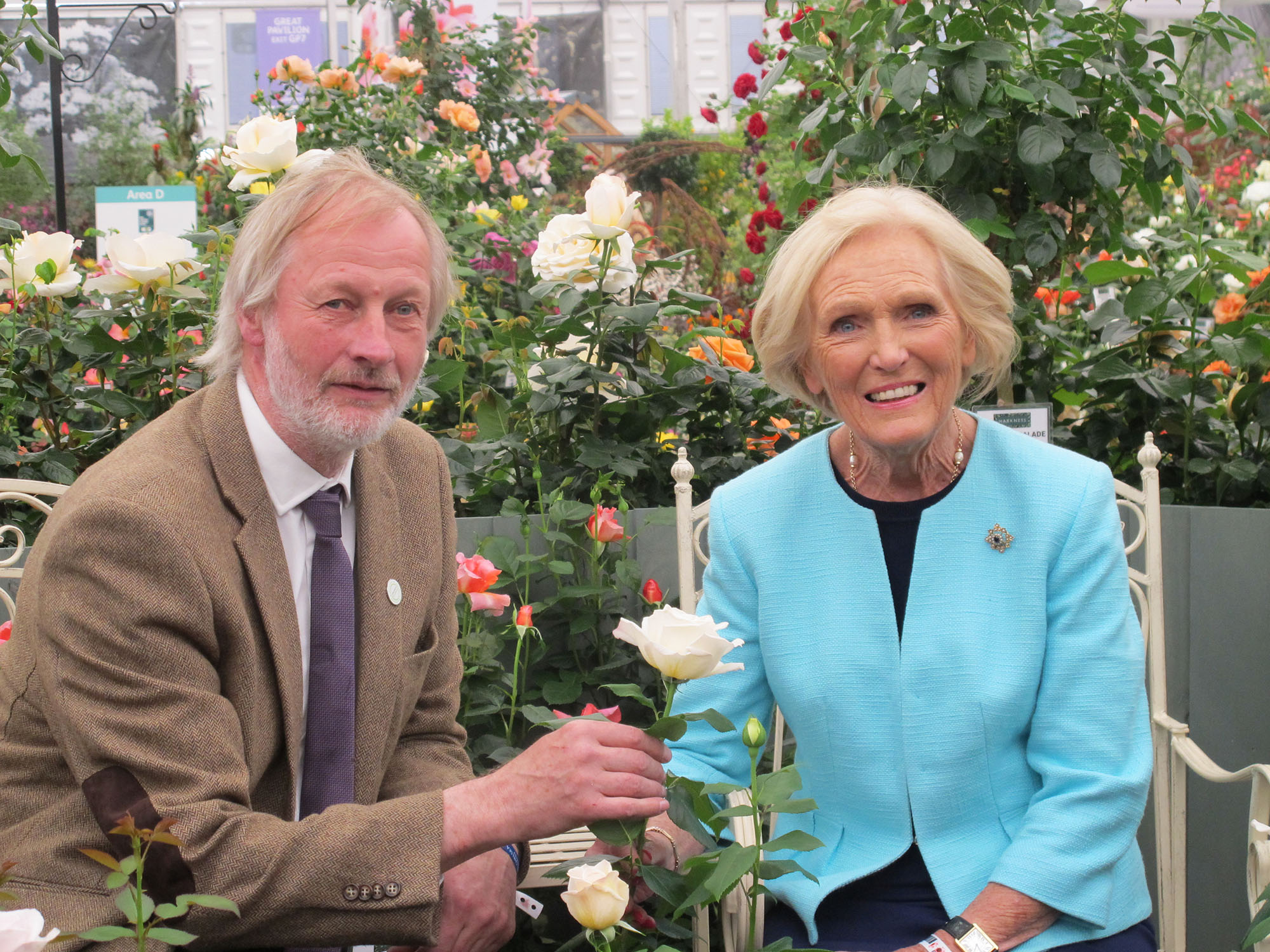
I do have one or two hybrid teas in my cutting garden and the best by far is ‘Chandos Beauty’ a highly scented pearlescent pale-pink with flowers that unfurl from large scrolled buds held on extremely strong stems. It was raised by Harkness Roses and it’s another AGM rose. It’s highly popular with the cut-flower ladies and one stem will make a bridal bouquet, so I’m told. The similar rose ‘Mary Berry’ has lemon-white flowers but this is a weaker rose. Mary selected it from the rose field herself and she’s pictured (by me) at the Chelsea Flower Show launch. Hybrid teas can be cut back to between six and eight inches, although I normally take them down to a foot because I have such a cold garden.
Rambling roses are probably the first group of roses to tackle, because they send new pliable stems from the base in most cases. These are flexible in November and December, but less so after Christmas, so try to tackle them before the new growth becomes brittle. They are a healthy bunch, mainly flowering just the once in June. Don’t let that put you off. Summer-flowering roses drip with flower and they make June abundant and exuberant, so every gardener needs to have some ‘once and only’ summer-flowering roses in their patch. You can always add a viticella clematis as a follow-up act.
Ramblers vary in size and some, such as ‘Kiftsgate’ are too vigorous and large for the average garden. I have two absolute favourites here. ‘Goldfinch’ is a restrained grower with clusters of small apricot-yellow flowers that fade to cream to milk-white. Graham Stuart Thomas described the scent as a mixture of bananas and oranges, although he didn’t like the way the flowers faded. I love that jaded look and I can’t detect a fruit bowl when I plunge my nose into the flowers. ‘Goldfinch’ was raised in 1907 by George Paul of Cheshunt in Hertfordshire and it’s almost thornless, so very easy to train.
The technique with ramblers is to look for the new olive-green stems coming from the base and then to remove the same number of older stems at the base. If you have two new stems, take out two older darker ones. You will probably need a pruning saw to do this. Take the pliable news stems and tie them in. If it’s grown on an upright, coil the rose stems round, loop them on a pergola (like one of those caterpillars) or bend them downwards. This slows the sap and produces more flower buds. ‘Goldfinch’ pairs well with the dark-purple Clematis ‘Etoile Violette’, because the clematis ( one of the very, very best) flowers after the rose is over.
My other great love is the rambling ‘Astra Desmond’, raised by Rockford in 1916. The foliage is a paler green, like young lettuces just hearting up, and the clusters of 30 or so ragged-edged flowers are gardenia-white with golden middles. This sprawls over a low wall to great effect here. I’ve also got the very vigorous pale silver-pink ‘Lauré Davoust’ climbing into a tree and she produces a few of her old-fashioned, flat-faced flowers in later summer, after her main flush is over.
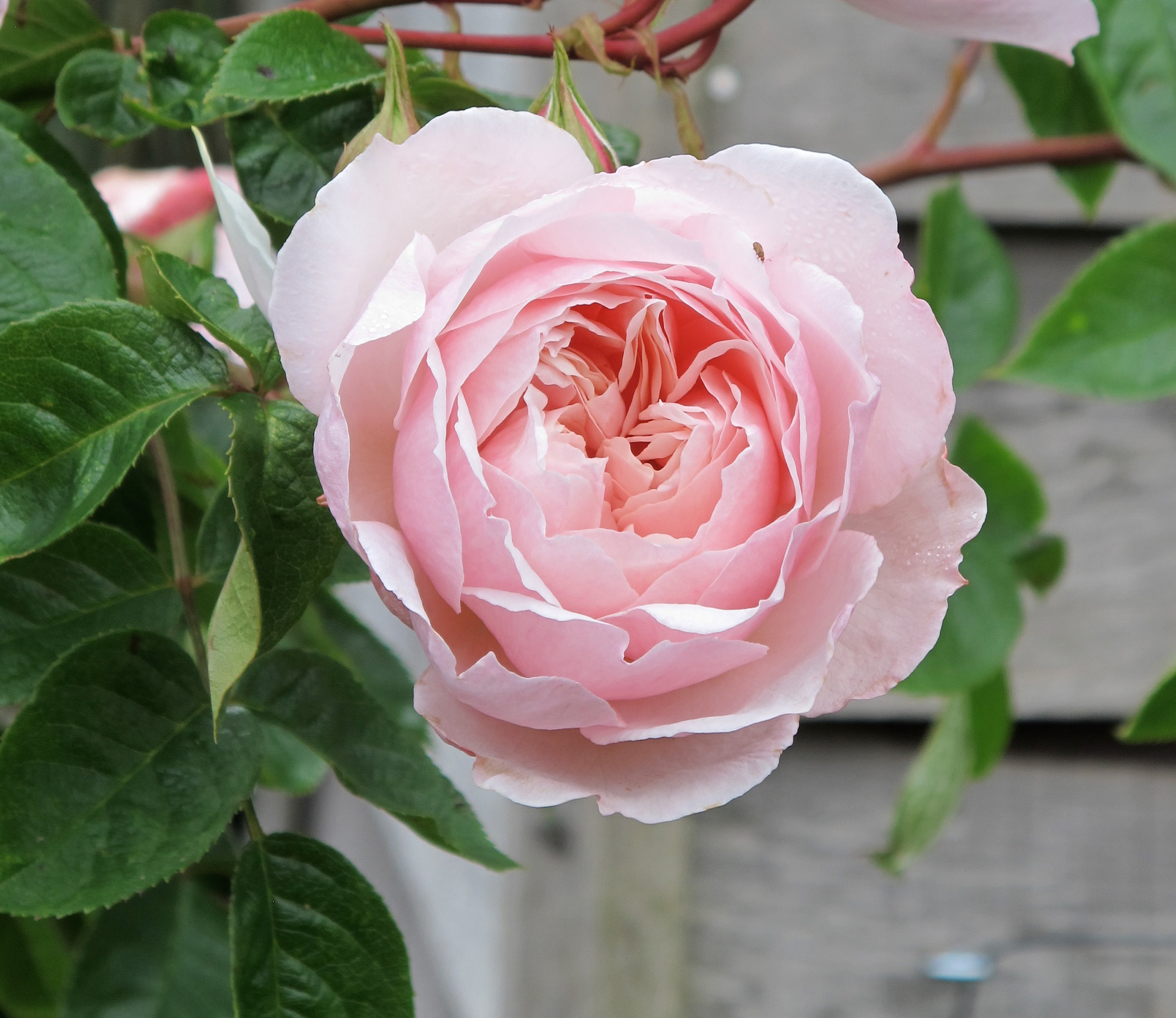
Lots of my roses span the low walls on the southern side of the cottage and they flow over the wall towards the sun. I have to go into the field to appreciate them. Favourites include ‘The Generous Gardener’, a large David Austin rose now listed as a climber. ‘Gardenia’, a thorny cream-white noisette with dark foliage, seems to like it there, and I’ve got ‘Pippin’. It’s a large bush rose commemorating Peter Beales who died in 2013. I knew Peter very well and travelled to Japan on many occasions, to lecture with him, so this rose holds a special place in my heart. Pippin was his nick name as a baby, because he had very rosy cheeks.
The roses on the wall and tidied up, sometimes my neighbour’s donkey give them another go in late spring when the sheep are up the filed for lambing. They shaped, rather than carefully pruned, but it’s all done with my wonderful Felcos! Memo to self. Put them back in your holster Val, or you will get the metal detector this Christmas.