




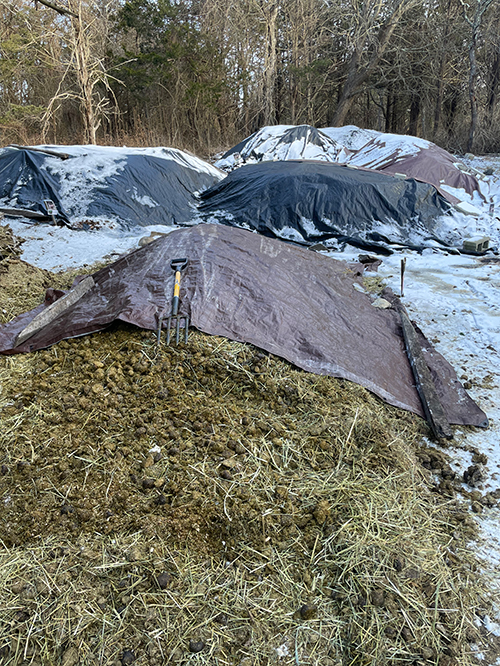
Last month I looked at the highly acidic pH results of my garden soil test, and this month I’ll say more about what else I’ve learned from that testing. One lesson is that I made a big mistake by dumping a trailer load of fresh horse manure onto my garden beds, partly because my compost bins were full, but also because I thought that this was a good way to add nutrients to the soil. As it turns out, it’s not. Applying fresh manure that’s not yet composed has several undesirable effects. First, it lowers pH. Second it raises phosphorus levels. And third, it usually adds lots of weed seeds to the soil. So manure fresh from the stable needs to be well rotted before it’s used.
My soil test provided other interesting results besides pH. I learned that the levels of calcium, magnesium, and phosphorus in my outdoor beds were all above optimum, that the level of potassium was below optimum, and that the level of sulfur was within the normal range. Trace elements, such as boron, copper, iron, manganese, and zinc, were also in normal amounts. The testers said that an elevated calcium level is an indication of a recent compost application and recommended a follow-up test in six months to see if the calcium level is decreasing as compost rots down. This I plan to do.
The test result that concerned me most was a somewhat elevated level of lead in the soil of two outdoor beds. The level was 122 in one bed and 142 in other bed, whereas the optimum level is below 100. My readings weren’t cause for great alarm because a warning to stop growing crops only comes with a lead level above 400. But still, these somewhat elevated levels are something I want to better understand. They were found in beds that had been covered with both seaweed and manure, and I wonder if these additives could have been partly responsible.
Interestingly, the soil in my greenhouse, which was built where a very old garage used to be, had low levels of lead. Perhaps that’s because I replaced most of the soil there after constructing the greenhouse, although I always wondered if some contaminants might have been left. Apparently, they weren’t, at least regarding lead. Interestingly too, sulfur levels in this bed were 170 compared to the normal range of 0 to 100. The level of phosphorus was also high, but the potassium level was below optimum. The testers at the University of Connecticut suggested that this soil needs added nitrogen and potash to better balance it. They also suggested retesting in spring after I’ve added more lime.

All these results show how important garden soil testing can be. By optimizing nutrient and pH levels for the plants that are to be grown, crop yields can be increased dramatically. It therefore makes sense for the soil in every garden be tested every few years to be sure it’s optimum for the gardener’s needs.