




I routinely grow a number of different squashes, some of which do best in my outdoor garden, while other more tropical ones are better suited to my greenhouse. Among my outdoor-grown varieties are summer squashes such as zucchini and yellow crookneck. Both can be grilled, stir-fried, or used in salads, plus the flowers can be stuffed or battered for a delicious snack. These summer squash plants need a watchful eye, however. They must be inspected daily as soon as they start to produce because in well-fertilized, well-watered beds the fruits can grow to mammoth proportions with astonishing speed. (I leave any giant squash on friend’s doorsteps!)
Also in my outdoor garden I grow many winter squashes, usually in areas where other crops are harvested early (by mid-June). These early-harvest locations free up lots of space, which is essential because winter squash plants are vining and tend to take over an entire bed. In the past, I’ve tried training winter squash plants to grow up the fence surrounding my garden, but large fruits will need to be supported before they pull down the entire vine. This doesn’t work if you are growing giant pumpkin!
Some of the winter squashes I grow are kabocha, red kuri, butternut, acorn, and a few pumpkin-like edible squashes such as Rouge vif d’Etampes (a bright red-orange French heirloom variety) and Galeux d’Eysines (a warty–looking French heirloom that’s good for pies). I try to have one or two plants of each variety, but quite often there’s a battle with insects, slugs, and birds. Wrapping some tinfoil around the base of the vine for about a foot (0.4M) tends to at least keep squash beetle larva at bay.
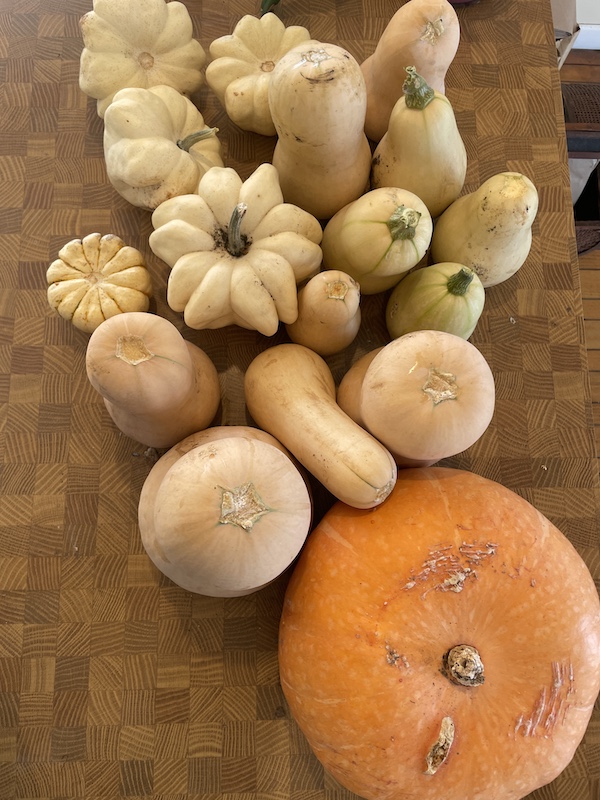
Butternut squash is my most prolific winter squash variety, which is fortunate because it has so many culinary uses. For pies, tarts, and soups especially, it can be roasted, pureed, and frozen for later fall or wintertime use. In this way, I can process together a large number of butternut squashes on a rainy afternoon and have the frozen puree ready whenever I need it. To me, this is greatly preferable to letting many of these squashes sit on my kitchen counter awaiting individual use and risking becoming mealy over time.
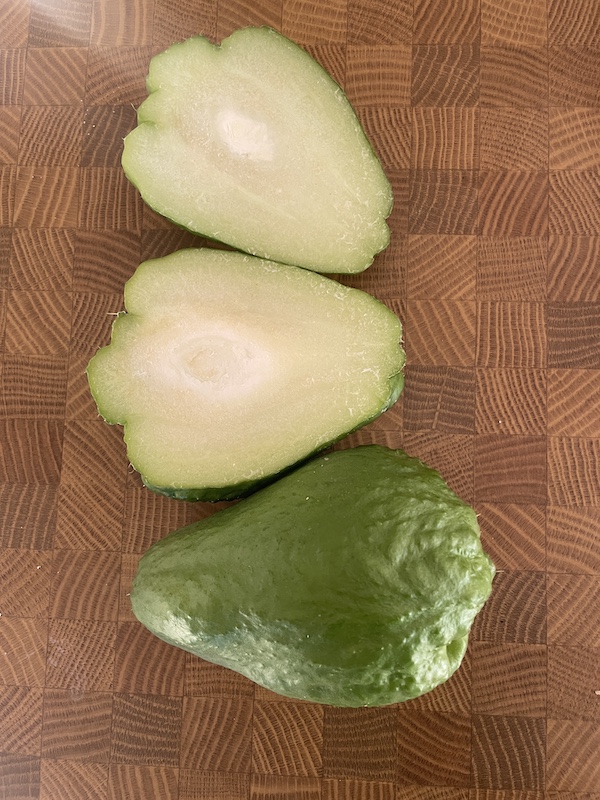
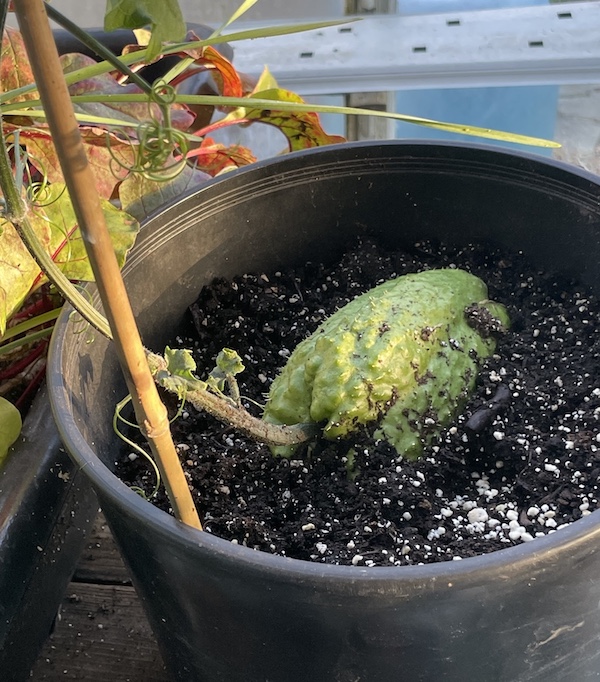
As for greenhouse-grown squashes, chayote squash has been a new addition this year that was gifted from a friend. This friend gave me three of these squashes, one with the shoot already poking from the top and the root beginning to show. At this stage, it’s ready to be potted into fertile soil and kept moist, waiting for the vine to grow. Chayote squash, which is native to Mexico, is usually grown in southern U.S. states, such as Louisiana, where it’s typically known as mirliton and considered quite versatile in the kitchen. In a northern U.S. state like Rhode Island, it can also be cultivated in a heated greenhouse as long as temperatures there don’t fall below 50ºF (10ºC). While researching this plant, I learnt that a single chayote vine can grow up to 30 feet (9.2 M) and sometimes produce as many as 30 squashes. Still, it should be fun to grow if it lasts the winter months.